Preexisting online Language Arts games are composed of a handful of categories. Observing a small sample pool, there are simple point-and-click games where the player indicates a certain type of speech, online flashcards and quizzes, and two games similar to Mad Libs. There are aesthetic skins over them that seem like parts of a larger story, but ones that try to emphasize humor seem more likely to be entertaining.
There are a few effective "theatrical" games used to teach young students basic language arts skills, all played by a group of children sitting in a circle. Precision of language, for example, is taught in a game named "Minefield" by having a student close their eyes and let other students tell them exactly how they must step to walk through the circle and avoid objects scattered on the floor. There are also unstructured role-playing exercises that tie into various reading material, which could easily be gamified with the addition of a reward system.
Game-like methods of teaching Language Arts also include having students use different apps and programs to tell stories, like making use of GarageBand to write a song about themselves (and secretly learn about rhyme, meter and other aspects of poetry). There are other ways that teachers use technology, like having students communicate through video dialogues, which are tangential to the lessons but teach useful skills. Also, of note is "Sonic Odyssey", a game made with the program GameMaker that puts Sonic the Hedgehog through the events of Homer's Odyssey. Perhaps more game-companions can be made to other pieces of literature?
One teacher has also tried to teach a small unit (three days worth of lessons) using the PC game Morrowind. It was used to teach choices and consequences, in the vein of "You can choose to steal, and the consequence is that the game treats you differently and other characters don't like you". This led to engagement among students that were previously very laid-back and stayed in the back of the room, and it sparked discussion among the students.
The company Amplify has made a series of education tablet games for a variety of subjects to be used in public schooling. English Language Arts games include two puzzle games, a choose-your-own-adventure story, and a collectible trading card game featuring famous characters from, and authors of, classic literature. Some of these are sold based on their aesthetics (one is simply described as being "based on Japanese folklore"), and others are described only based on what they teach- the fun here is unoptimized.
Sources:
Amplify To Offer Games for Middle School Instruction. (Cover story). Electronic Education Report [serial online]. June 24, 2013;20(13):1-6. Available from: Academic Search Complete, Ipswich, MA. Accessed September 23, 2014.
Bernard, Sara. "How to Teach with Technology: Language Arts." Edutopia. N.p., 13 Apirl 2014. Web. 23 September 2014.
Fennessey S. Using theater games to enhance language arts learning. Reading Teacher [serial online]. April 2006;59(7):688-691. Available from: Academic Search Complete, Ipswich, MA. Accessed September 23, 2014.
Kadakia M. Increasing Student Engagement by Using Morrowind to Analyze Choices and Consequences. Techtrends: Linking Research & Practice To Improve Learning [serial online]. September 2005;49(5):29-32. Available from: Academic Search Complete, Ipswich, MA. Accessed September 23, 2014.
Lanley, Jimmie. "10 Best Online Games for Homeschool Language Arts." Jimmies Collage. N.p., 26 Sept. 2011. Web. 23 Sept. 2014.
Tuesday, September 23, 2014
Wednesday, September 17, 2014
Game Design: Ethics Continued
Let's talk about metaethics.
Metaethics is ethics about ethics, or the branch of moral philosophy that deals with dealing with branches of moral philosophy. "How can I do the most good?" is a question of ethics, while "What do I mean when I say 'good', and what should I mean by it?" is a question of metaethics.
This is a very recursive, sticky subject matter, which makes it a challenge to gamify. Ethics is a very simple subject for a game- do good or bad and you come closer to a certain payoff, bonus, or win condition. Or, as I previously mentioned, choose between two alternatives and try to find the solutions that you can best live with. Making a mechanic that's about ethics without directly involving ethics is difficult, and prototypical examples are thin on the ground.
There are plenty of games where the player is meant to decide for themselves what they want and work towards it- in a sense, this involves decisions about what decisions to make. A game like Minecraft can involve this in a limited sense, although its impact is so small that it hardly registers. The Stanley Parable, where the player can choose to follow one of many paths through binary choices of (obey/disobey) and none of the paths is explicitly "right", offers this in a higher capacity.
Still, a game truly about metaethics would not just involve the player reasoning about what is good and bad- it would be an implanted feature in the game. A person playing a sandbox game is not usually penalized (though they may be challenged) when they get bored and start trying to destroy things, because the point of Simpsons Hit and Run is not to be saintly. Likewise, a person could turn off the sound and have a random number generator or a coin flip decide their path in The Stanley Parable, and be no better or worse off for it.
The best solution I propose is a simulation game, something in the vein of the Sims, where certain behaviors are based on certain beliefs. This already exists in the rough form of Dwarf Fortress, an ASCII-based game which has been in continuous development for a century, and which simulates a fantasy world in such detail that it can crash computers despite having alphabet-soup graphics. While players in Dwarf Fortress don't need to be very moral, there are two important elements in it that should be kept in mind:
1. Players experiment often, even to their detriment. The motto of the fanbase is "Losing is fun!" and they regularly try to break the half-baked physics engine or otherwise game the system. People have tunneled into Hell and survived, farmed mermaids for their bones, created capsules that could maintain dwarf life inside of magma, and turned dangerous beasts into security systems. (Here's a small list of dwarven achievements.)
2. The game's code can be edited by anyone playing it, in a very simple coding language that's easy to pick up. This has led to mods which change the game world into the Fallout universe, or the world of My Little Pony, as well as dirty tricks like pausing the game during an invasion, raising the natural temperature of the invaders to an absurdly high number, unpausing and letting them all spontaneously combust.
This has led to a community that's actively trying to dismantle, break, and improve the game, and sees rampant experimentation as fun in its own right. This community is what makes Dwarf Fortress fun, despite the punishing learning curve presented in understanding anything that's happening and preventing your dwarves from starving to death in their first week.
In the Metaethics Game, there would be many, many axes of moral and immoral behavior, some of them likely alien. A player would be able to command a group of people- let's say a small town, although in practice this is an aesthetic skin that could be swapped out for whatever's most convenient- and influence their behavior. The goal of each game would be to maximize a certain number of these moral qualities, the number being determined by the difficulty chosen. The qualities would be randomized, but having a high or a low amount in any of them would be cued by the game, using a message like [Quality 1 is waning...]. The strategy of "increase all qualities to maximum" would be prevented by having certain qualities conflict, or only providing enough resources to deal with some of them at a time.
This is a rudimentary idea, using specially-named point allocation that's programmed to lead to, and stem from, certain NPC actions. It's an experimenting game, sure, and it involves deciding whatever has been deemed "right" in the current context, but this is still rather lacklustre. The real fun of the game, no matter how much effort went into its design, would inevitably come from the community, who would quickly program in new, interesting qualities and start passing them around.
This would lead to a Baby Eating Simulator 1.5.6, for such is the way of the internet, but it would also influence how people think of and interact with moral questions and values. The game would dole out the majority of its fun by making its players work in a meta-space, creating and testing new and strange versions of itself. Without dialogue, text, or other explicit markers, that is the best way I've come up with to teach metaethics.
Sources:
Adams, Tarn. "Dwarf Fortress" 17 Sept 2014. Bay12 Games. 17 Sept 2014.
"Awesome: Dwarf Fortress". TVTropes. 17 Sept 2014.
Dwarf Fortress. Tarn Adams & Kitsap Sun. Apr 6, 2013. YouTube. 17 Sept 2014.
Sayre-Mccord, Geoff. "Metaethics" 26 Jan 2012. The Stanford Encyclopedia of Philosophy. 17 Sept 2014.
Simpsons' Hit and Run Homer vs Police. Lucas Cardellini. 17 Oct 2007. YouTube. 17 Sept 2014.
Metaethics is ethics about ethics, or the branch of moral philosophy that deals with dealing with branches of moral philosophy. "How can I do the most good?" is a question of ethics, while "What do I mean when I say 'good', and what should I mean by it?" is a question of metaethics.
This is a very recursive, sticky subject matter, which makes it a challenge to gamify. Ethics is a very simple subject for a game- do good or bad and you come closer to a certain payoff, bonus, or win condition. Or, as I previously mentioned, choose between two alternatives and try to find the solutions that you can best live with. Making a mechanic that's about ethics without directly involving ethics is difficult, and prototypical examples are thin on the ground.
There are plenty of games where the player is meant to decide for themselves what they want and work towards it- in a sense, this involves decisions about what decisions to make. A game like Minecraft can involve this in a limited sense, although its impact is so small that it hardly registers. The Stanley Parable, where the player can choose to follow one of many paths through binary choices of (obey/disobey) and none of the paths is explicitly "right", offers this in a higher capacity.
Still, a game truly about metaethics would not just involve the player reasoning about what is good and bad- it would be an implanted feature in the game. A person playing a sandbox game is not usually penalized (though they may be challenged) when they get bored and start trying to destroy things, because the point of Simpsons Hit and Run is not to be saintly. Likewise, a person could turn off the sound and have a random number generator or a coin flip decide their path in The Stanley Parable, and be no better or worse off for it.
The best solution I propose is a simulation game, something in the vein of the Sims, where certain behaviors are based on certain beliefs. This already exists in the rough form of Dwarf Fortress, an ASCII-based game which has been in continuous development for a century, and which simulates a fantasy world in such detail that it can crash computers despite having alphabet-soup graphics. While players in Dwarf Fortress don't need to be very moral, there are two important elements in it that should be kept in mind:
1. Players experiment often, even to their detriment. The motto of the fanbase is "Losing is fun!" and they regularly try to break the half-baked physics engine or otherwise game the system. People have tunneled into Hell and survived, farmed mermaids for their bones, created capsules that could maintain dwarf life inside of magma, and turned dangerous beasts into security systems. (Here's a small list of dwarven achievements.)
2. The game's code can be edited by anyone playing it, in a very simple coding language that's easy to pick up. This has led to mods which change the game world into the Fallout universe, or the world of My Little Pony, as well as dirty tricks like pausing the game during an invasion, raising the natural temperature of the invaders to an absurdly high number, unpausing and letting them all spontaneously combust.
This has led to a community that's actively trying to dismantle, break, and improve the game, and sees rampant experimentation as fun in its own right. This community is what makes Dwarf Fortress fun, despite the punishing learning curve presented in understanding anything that's happening and preventing your dwarves from starving to death in their first week.
In the Metaethics Game, there would be many, many axes of moral and immoral behavior, some of them likely alien. A player would be able to command a group of people- let's say a small town, although in practice this is an aesthetic skin that could be swapped out for whatever's most convenient- and influence their behavior. The goal of each game would be to maximize a certain number of these moral qualities, the number being determined by the difficulty chosen. The qualities would be randomized, but having a high or a low amount in any of them would be cued by the game, using a message like [Quality 1 is waning...]. The strategy of "increase all qualities to maximum" would be prevented by having certain qualities conflict, or only providing enough resources to deal with some of them at a time.
This is a rudimentary idea, using specially-named point allocation that's programmed to lead to, and stem from, certain NPC actions. It's an experimenting game, sure, and it involves deciding whatever has been deemed "right" in the current context, but this is still rather lacklustre. The real fun of the game, no matter how much effort went into its design, would inevitably come from the community, who would quickly program in new, interesting qualities and start passing them around.
This would lead to a Baby Eating Simulator 1.5.6, for such is the way of the internet, but it would also influence how people think of and interact with moral questions and values. The game would dole out the majority of its fun by making its players work in a meta-space, creating and testing new and strange versions of itself. Without dialogue, text, or other explicit markers, that is the best way I've come up with to teach metaethics.
Sources:
Adams, Tarn. "Dwarf Fortress" 17 Sept 2014. Bay12 Games. 17 Sept 2014.
"Awesome: Dwarf Fortress". TVTropes. 17 Sept 2014.
Dwarf Fortress. Tarn Adams & Kitsap Sun. Apr 6, 2013. YouTube. 17 Sept 2014.
Sayre-Mccord, Geoff. "Metaethics" 26 Jan 2012. The Stanford Encyclopedia of Philosophy. 17 Sept 2014.
Simpsons' Hit and Run Homer vs Police. Lucas Cardellini. 17 Oct 2007. YouTube. 17 Sept 2014.
Wednesday, September 10, 2014
Game Design: Introduction to Ethics
For the uninitiated: ethics is the school in philosophy of determining right from wrong. It has some Socratic history, but the person to establish the branch of Ethics was Aristotle, in a set of ten scrolls entitled Nichomachean Ethics. As a branch, it's about moral systems, how we create them, and the meaning of words like "moral", but for the most part it's brought into arguments where people disagree about whether something is good or evil.
This is one field that game designers are already very fond of, so it's a perfect jumping-off point. Not to mention that most people have a common-sense grasp of it to begin with. People might not know the word "utilitarianism", for instance, but they could recognize the concept pretty easily. There are already games that exemplify personal conflict between moral systems- usually through moral dilemmas- and leave the player to decide for themselves what they can live with.
Games have been trying to give options towards moral and immoral ever since Gary Gygax invented D&D's alignment system, and they continue to exist today with the Paragon/Renegade paths in Mass Effect games, the choices shown in Infamous, and plenty of other basic decisions that can be added to games with little effort.
This lets designers include non-intrusive mechanics that make the player feel more individual, and more special, without putting much time or effort in- by all rights, a "morality bar" is a useless concept unless the player has an implicit goal to reach one end of it. Because of this, most games which feature them require that you be one extreme or the other, or as Zero Punctuation's Ben Croshaw put it, "Mother Teresa or baby-eating", before the very end.
If I decide to do something more fun to me, like avoiding killing anything for the added challenge of pacifism, but also stealing from lots of people to make up for the necessary resources I can't get from kills, I'm on neither end of the scale, and all of the best paths are closed to me. I'm not good or evil, I'm creative and pragmatic, and the game doesn't reflect that because there are only so many variables you can program into a graph before it becomes incomprehensible. This is not a good example of how ethics work, or how they should. What's worse, any scale like this is doomed to fail, and a lot of games that could benefit from a morality-mechanic just don't have the budget and time to build a complicated-enough substitute.
The answer to this problem lies in an arcade game (later adapted into an Atari 2600 cartridge) named Missile Command. Missile Command first arrived in 1980, and it had a very simple trackball-and-buttons control system. I was lucky enough to find one in an Indiana restaurant in 2013, and I know from experience that it is punishingly difficult.
The game is simple enough- there are 6 cities at the bottom of the display, and nuclear missiles fall at each of them. The player controls a targeting reticule and the missiles of the cities- when a button was pressed, the appropriate city would fire a missile which intercepts the reticule's current location. When a city's destroyed, it's destroyed permanently, and there are no extras to accumulate. The game is simply a battle against the odds.

Missile Command, without words, asks a horribly difficult question: what are you willing to sacrifice? The game is manageable at first, but there is no win-condition, and you only lose only all 6 cities are destroyed. Do you let one be destroyed in a nuclear explosion to keep the other 5 better-protected, or do you risk having to stop two or three missiles at once and freezing up? Although it's made of the simplest polygons, this game was meant to convey dread, and that's a job it does well.
Dread, as it happens, is wonderful soil for tough moral decisions. For instance, Pathologic, a Russian game that has been described by its biggest fans as not remotely fun, is full of moral uncertainties. In it, the player is one of three healers in a town on the Russian steppe, which is hit by a mysterious and malevolent disease known as sand plague. Staying alive means allocating your resources well, ingratiating yourself with others in the town, learning to game the local economy as it falls apart, and fighting to keep yourself and others alive. These goals often come into conflict, and you must weigh the chances of your survival against the death of other people.

In Missile Command and Pathologic, there's no need for a morality bar. In Pathologic, there is the exception that people will dislike you if you do certain things, and you must be philanthropic to regain their trust, but this is just another way of setting a dilemma (being liked in the unstable town full of murderous people vs. keeping that life-saving medicine you might need in a day's time). The player must always be responsible for their own actions, and when the options aren't divided into a fixed dichotomy and given point-values, it suddenly becomes a lot more troubling.
This is a simple method for turning a philosophical quandary into something playable- to be more specific, the Trolley Problem. The Trolley Problem, which was first written in 1967 by Phillipa Foot, is set up like so: a runaway trolley is coming down the railroad tracks, heading straight for five people who are tied to them, and you're at the lever which switches tracks and can prevent this, but the side track has one person tied to it. Your only options are to do nothing or to pull the lever- answers like pulling it halfway and derailing the trolley are clever, but they're not the point of the exercise. Which is the correct answer to this problem?

It's a question of resources, not conceptually any different from having only so many bullets or heals for a certain target. You have the ability to perform one of two actions, and each one will lose you something the other would've given you. That's the simplest way to make someone agonize over a decision, whether it's deciding whether to pull the lever or working out which Perks you really want in a Fallout game. It forces whoever participates in it to figure out which things they value most, and to do so under time-pressure.
Of course, as previously stated, sometimes budgets of one kind or another are just too small, and a bar's all a studio can fit into their game. For that, the best way to make things more interesting, as the Extra Credits team has pointed out (see below), is to add another two categories, rename all of them, and make it a line graph instead.
For instance, in a Tolkienesque fantasy game, the four qualities could read something like "lawful" and "anarchic" or "Dwarven" and "Elven". For the sake of the example, let's say that lawful-anarchic and Dwarven-Elven are our dichotomies. Instead of netting you a simple plus or minus, every decision is now multifaceted- yes, that decision will open up more anarchic opportunities, and I don't want to be a self-righteous bureaucrat or anything, but is that really worth losing my rapport with the elves? For a different challenge in the same theme, you could judge the player for their decisions based on oddball or alien standards.
Morality is often seen as something we achieve rather than do, but in a game-environment "achieve" can be a loaded word. Trying to maximize your score in the direction that happens to be named "good" is very different from making the toughest decisions and learning what you really are and aren't willing to do, and while the former is surely more fun for some, the latter is more rewarding in the long-term. Games are a sandbox, and deciding that some action is wrong is much better in a simulation than making that mistake out in monkeyspace.
Sources:
Aristotle. Ethics: The Nichomachean Ethics. Baltimore: Penguin, 1966. Print. 7 September 2014.
BIOSHOCK (Zero Punctuation). Ben "Yahtzee" Croshaw. 21 July 2011. The Escapist/YouTube. 10 September 2014.
Clark, Josh. "How the Trolley Problem Works" 03 December 2007. HowStuffWorks.com. 10 September 2014.
Rubens, Alex. "The Creation of Missile Command and the Haunting of Its Creator, Dave Theurer" 15 August 2013. Polygon.com. 10 September 2014.
Smith, Quintin. "Butchering Pathologic" 10 April 2008. Rock Paper Shotgun. 9 September 2014.
Video Games and Moral Choices. James Portnow, Daniel Floyd, & Allison Theus. 16 April 2010. The Escapist/YouTube. 10 September 2014.
This is one field that game designers are already very fond of, so it's a perfect jumping-off point. Not to mention that most people have a common-sense grasp of it to begin with. People might not know the word "utilitarianism", for instance, but they could recognize the concept pretty easily. There are already games that exemplify personal conflict between moral systems- usually through moral dilemmas- and leave the player to decide for themselves what they can live with.
Games have been trying to give options towards moral and immoral ever since Gary Gygax invented D&D's alignment system, and they continue to exist today with the Paragon/Renegade paths in Mass Effect games, the choices shown in Infamous, and plenty of other basic decisions that can be added to games with little effort.
This lets designers include non-intrusive mechanics that make the player feel more individual, and more special, without putting much time or effort in- by all rights, a "morality bar" is a useless concept unless the player has an implicit goal to reach one end of it. Because of this, most games which feature them require that you be one extreme or the other, or as Zero Punctuation's Ben Croshaw put it, "Mother Teresa or baby-eating", before the very end.
If I decide to do something more fun to me, like avoiding killing anything for the added challenge of pacifism, but also stealing from lots of people to make up for the necessary resources I can't get from kills, I'm on neither end of the scale, and all of the best paths are closed to me. I'm not good or evil, I'm creative and pragmatic, and the game doesn't reflect that because there are only so many variables you can program into a graph before it becomes incomprehensible. This is not a good example of how ethics work, or how they should. What's worse, any scale like this is doomed to fail, and a lot of games that could benefit from a morality-mechanic just don't have the budget and time to build a complicated-enough substitute.
The answer to this problem lies in an arcade game (later adapted into an Atari 2600 cartridge) named Missile Command. Missile Command first arrived in 1980, and it had a very simple trackball-and-buttons control system. I was lucky enough to find one in an Indiana restaurant in 2013, and I know from experience that it is punishingly difficult.
The game is simple enough- there are 6 cities at the bottom of the display, and nuclear missiles fall at each of them. The player controls a targeting reticule and the missiles of the cities- when a button was pressed, the appropriate city would fire a missile which intercepts the reticule's current location. When a city's destroyed, it's destroyed permanently, and there are no extras to accumulate. The game is simply a battle against the odds.
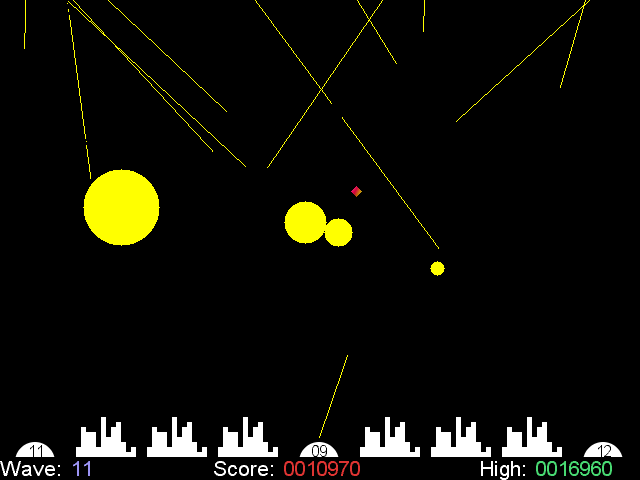
Missile Command, without words, asks a horribly difficult question: what are you willing to sacrifice? The game is manageable at first, but there is no win-condition, and you only lose only all 6 cities are destroyed. Do you let one be destroyed in a nuclear explosion to keep the other 5 better-protected, or do you risk having to stop two or three missiles at once and freezing up? Although it's made of the simplest polygons, this game was meant to convey dread, and that's a job it does well.
Dread, as it happens, is wonderful soil for tough moral decisions. For instance, Pathologic, a Russian game that has been described by its biggest fans as not remotely fun, is full of moral uncertainties. In it, the player is one of three healers in a town on the Russian steppe, which is hit by a mysterious and malevolent disease known as sand plague. Staying alive means allocating your resources well, ingratiating yourself with others in the town, learning to game the local economy as it falls apart, and fighting to keep yourself and others alive. These goals often come into conflict, and you must weigh the chances of your survival against the death of other people.
In Missile Command and Pathologic, there's no need for a morality bar. In Pathologic, there is the exception that people will dislike you if you do certain things, and you must be philanthropic to regain their trust, but this is just another way of setting a dilemma (being liked in the unstable town full of murderous people vs. keeping that life-saving medicine you might need in a day's time). The player must always be responsible for their own actions, and when the options aren't divided into a fixed dichotomy and given point-values, it suddenly becomes a lot more troubling.
This is a simple method for turning a philosophical quandary into something playable- to be more specific, the Trolley Problem. The Trolley Problem, which was first written in 1967 by Phillipa Foot, is set up like so: a runaway trolley is coming down the railroad tracks, heading straight for five people who are tied to them, and you're at the lever which switches tracks and can prevent this, but the side track has one person tied to it. Your only options are to do nothing or to pull the lever- answers like pulling it halfway and derailing the trolley are clever, but they're not the point of the exercise. Which is the correct answer to this problem?

It's a question of resources, not conceptually any different from having only so many bullets or heals for a certain target. You have the ability to perform one of two actions, and each one will lose you something the other would've given you. That's the simplest way to make someone agonize over a decision, whether it's deciding whether to pull the lever or working out which Perks you really want in a Fallout game. It forces whoever participates in it to figure out which things they value most, and to do so under time-pressure.
Of course, as previously stated, sometimes budgets of one kind or another are just too small, and a bar's all a studio can fit into their game. For that, the best way to make things more interesting, as the Extra Credits team has pointed out (see below), is to add another two categories, rename all of them, and make it a line graph instead.
For instance, in a Tolkienesque fantasy game, the four qualities could read something like "lawful" and "anarchic" or "Dwarven" and "Elven". For the sake of the example, let's say that lawful-anarchic and Dwarven-Elven are our dichotomies. Instead of netting you a simple plus or minus, every decision is now multifaceted- yes, that decision will open up more anarchic opportunities, and I don't want to be a self-righteous bureaucrat or anything, but is that really worth losing my rapport with the elves? For a different challenge in the same theme, you could judge the player for their decisions based on oddball or alien standards.
Morality is often seen as something we achieve rather than do, but in a game-environment "achieve" can be a loaded word. Trying to maximize your score in the direction that happens to be named "good" is very different from making the toughest decisions and learning what you really are and aren't willing to do, and while the former is surely more fun for some, the latter is more rewarding in the long-term. Games are a sandbox, and deciding that some action is wrong is much better in a simulation than making that mistake out in monkeyspace.
Sources:
Aristotle. Ethics: The Nichomachean Ethics. Baltimore: Penguin, 1966. Print. 7 September 2014.
BIOSHOCK (Zero Punctuation). Ben "Yahtzee" Croshaw. 21 July 2011. The Escapist/YouTube. 10 September 2014.
Clark, Josh. "How the Trolley Problem Works" 03 December 2007. HowStuffWorks.com. 10 September 2014.
Rubens, Alex. "The Creation of Missile Command and the Haunting of Its Creator, Dave Theurer" 15 August 2013. Polygon.com. 10 September 2014.
Smith, Quintin. "Butchering Pathologic" 10 April 2008. Rock Paper Shotgun. 9 September 2014.
Video Games and Moral Choices. James Portnow, Daniel Floyd, & Allison Theus. 16 April 2010. The Escapist/YouTube. 10 September 2014.
Monday, September 1, 2014
Game Design - Philosophy and Games (Introduction)
For all of its history, humanity has tried to understand its nature, and its place in the universe, and this has been the greatest preoccupation of our writings and drawings and other creations. More than that, ever since Plato and Aristotle taught their various lessons to the Hellenistic world, philosophy has been a point of interest in Western culture, and communicating it has been the work of countless stories throughout all media. However we get there, we must acknowledge that countless stories have devoted themselves to showing us new ideas about the world, or building on old ones. To name a few:
In literature, we have Steppenwolf,
Infinite Jest, Notes From the Underground, Ulysses, Atlas Shrugged and Fight
Club. In film, there’s Inception, 12 Angry Men, Forrest Gump, Cloud Atlas, Patch
Adams, and The Matrix. Theatre provides us Rent, AIDA, Les Miserables,
Assassins, & Rosencrantz and Guildenstein Are Dead. Surely comics would be
the poorer without Watchmen, or television without Twin Peaks? All of these are
just the tip of a very large iceberg, one that stretches back almost as far as storytelling itself. To communicate vastly different ideas, and even complex systems of
them, is the province of fiction no matter the form it comes in.
Where, then, is the philosophy in Pong? What is communicated by Super Mario Bros. 2? What does Call of Duty teach us, beyond the virtues of aiming and not-being-aimed-at? Admittedly little, and to turn the messages they provide into philosophy would require mental contortions of the highest degree. However...
In film’s infancy, it was a vaudeville spectacle. In literature’s, it was campfire mythology and tales of trumped-up personal triumphs. In theatre, crude humor played for the lowest common denominator. Every medium, no matter how vast and intimidating, has its humble beginnings. Video games are mostly amusements today, but within a century of their creation we’re already growing out of that mode of thinking. Many games today, especially experimental ones like Dear Esther and Dinner Date, are trying at more complex themes and ideas, and it’s reasonable to assume that they’ll keep improving with time.
It’s important to remember that we now have the first truly interactive fictional medium, one where the audience does not simply serve as amanuensis to the author’s series of events, but plays an active role in them. This could be a golden opportunity to teach philosophical concepts, and wider systems of philosophical thought, through firsthand experience.
Games aren’t at any sort of renaissance on that front, at least for now, but they’re moving in the right direction. And so this series will cover how games represent different branches of philosophy, and how they could do more for them. To fill a 14-week schedule, there will be an introduction, 12 entries and a conclusion. 2 of those 12 entries will each be devoted to one of six branches of philosophy: Metaphysics, Politics, Aesthetics, Ethics, Logic, and Epistemology.
Each branch will have, by the end, an “Introduction to…” post outlining the nature of the branch and one or more surface-level aspects of it, how games represent those aspects (if they do), and how they could do so better. This will be followed by a “…Continued” post, which will give a more complex, in-depth topic from that branch the same treatment. For instance, “Introduction to Ethics” will involve ethical dilemmas in games, how systems of morality are represented in games, and how to gamify the Trolley Problem, while “Ethics Continued” will deal with a stranger beast like meta-ethics, virtue ethics, Epicurean hedonism, antinatalism, or the philosophies of Kant or de Sade.
Games have the power to teach us much more than simple patterns of behavior, or minor cognitive skills. They can teach us how to see the world through the eyes of others, and give the thinkers of the past new voices for the generations of today and tomorrow.
Monday, April 7, 2014
On the VALS Survey
Having just taken the VALS survey to determine what kind of consumer I am, I received a Primary Type of “Striver” and a Secondary of “Survivor”, which I’m told means that I’m primarily a person who really likes money and wants to be fashionable, and secondarily one who sticks only to favored brands and who thinks the world is changing too quickly. These are not accurate descriptions.
I don’t have any desire to appear wealthy, or to have a large amount of money. In fact, I can’t remember the last “big” purchase I made. I don’t own a television or car, my electronic devices are mostly obsolete by now, my music mostly comes from free distribution networks like Bandcamp and the FMA, most of the other entertainment I watch comes from webshows and podcasts, and I have no interest in appearing fashionable. The only thing I regularly pay for is food, and even that doesn’t cost much.
This all looks like a perfect opportunity to shift me to that “Survivor” designation, but even that’s untrue. It’s not that I consume cautiously, it’s that I try not to consume at all. I don’t trust labels, brands, and companies, not in the paranoid sense that I think they’re going to try to poison me, but in an ideological sense. I don’t want to be a mindless consumer, and I don’t want anyone but me to influence what I do and don’t purchase. It’s the principle of the thing: I’m the one piloting this life I have, and I’m not letting a bunch of garish logos and old white men in boardrooms steer me off course.
So, naturally, I don’t follow them on social networks, or know the major differences between competing ones, or feel particularly moved to go buy things by their advertisements. By any significant measure, the time I have to exist on this planet is incredibly short, and there are far more important things to do with that time than obsess over such superficial trivia as who endorses what shoe and which brand has fewer carbohydrates.
I’m sure that sounds incredibly self-important to some people, like I’m establishing my own superiority over the consumerist masses by saying that I’m oh-so-clever as to not bother with your paltry little systems. And that’s obviously not true. I’m not a feral child or a hermit, and I have to interact with companies constantly. The computer I’m writing on came from one, and so did my fridge, and so did the salt and pepper shakers I have. I might not use different brands with the same frequency as everyone else, but I do still need to use them.
The key difference is that I don’t find anything interesting about what brand I use. I’m not a member of the Coke Generation, I don’t define myself based on the fact that my mp3-player happens to be an Apple product, and I don’t treat my laptop as being more or less valuable because it has a name written on the back. At the end of the day, I drink cola because it tastes good, I use an mp3-player because I like music and radio theatre, and any laptop with a word processor, some storage and wireless internet access would suit my purposes pretty well. I don’t use any of these things to define myself as a person, just merely as devices fulfilling a function I’d like fulfilled.
In fact, the only material possessions I’ve really identified with are some cheap custom buttons I had made online, and a cheap trenchcoat I found in a thrift shop. That trenchcoat’s now ripped thanks to a rogue box of cat litter, and I hardly wear those buttons. Everything else I use is of purely practical value to me.
And, since the test is meant to explain how companies view me in order to show how they’d sell to me, how exactly would they get me to buy a product? The only time I’d buy their product is if I already required it and it was sufficiently nearby and cheap. No amount of advertising, endorsements or attempts at making it the cool, in thing would change that.
I suppose it would be possible to just bombard me with ads until the stars aligned and I needed a product they were offering, but that really would take too much money. I won’t pretend that I’m so culturally-steeled that I’m immune to all advertising, but it is mostly inconvenient for anyone to try selling me things. I don’t represent a customer at all, just a big empty space for brands to waste time and energy trying to get a profit from.
And I have to admit, a lot of this is just cyberpunk-mentality. From the word “go” I already don’t like companies, and I don’t want them faffing about in my business trying to ply their trades. As I’ve said, I have more important things to do than giving them attention and money.
Subscribe to:
Posts (Atom)