This is a common theme in a lot of philosophy, usually placed just before the author throws up their own ideas and treats them as the true nature of reality. Plato's Allegory of the Cave sets up the idea that people are like slaves chained to chairs in a cave, spending their lives unable to move and watching the shadows cast by objects moved in front of torches behind them. To those people, the shadows are reality, and someone who travelled out of the cave and saw the sun would not be able to talk to those people without sounding crazy.
Plato, of course, then goes on to describe his Theory of Forms: that everything in existence is a less perfect version of an idea floating around in a special world (for instance, each chair is just a "shadow" of the perfect Form of the Chair), and that before we were born we were timeless entities in the World of Forms. This sounds crazy, which Plato then takes this as confirmation that he's correct. Likewise, every religious leader, New Ager, chupacabra hunter, simulationist and Timecube believer can make an equal claim that they've got the right perception of reality, and that we're all too caught up in our own brains to understand the way things really are. Metaphysics is, often, a field dedicated to people who are trying to sell you something. And in a sense, every religious game ever made is a metaphysical game, though not really one that teaches the concept of metaphysics.

Metaphysics is by nature an investigative subject, but not really a scientific one. In the world as it is, there's not very far we can get using metaphysics, but there are plenty of things we can test and be pretty sure of in the physical world. Science itself doesn't make the claim that only the physical world exists, but it is based on the idea that the physical world is the only thing we have reliable methods of understanding- which is a position called methodological naturalism.
This is much less of a problem in a game, of course. Magic, ghosts, demons and gods are all around in the gaming community, but this isn't the real joy of the medium. In games, the designers not only control the player's perceptions, but the underlying nature of their reality. Endgame twists were made for this.
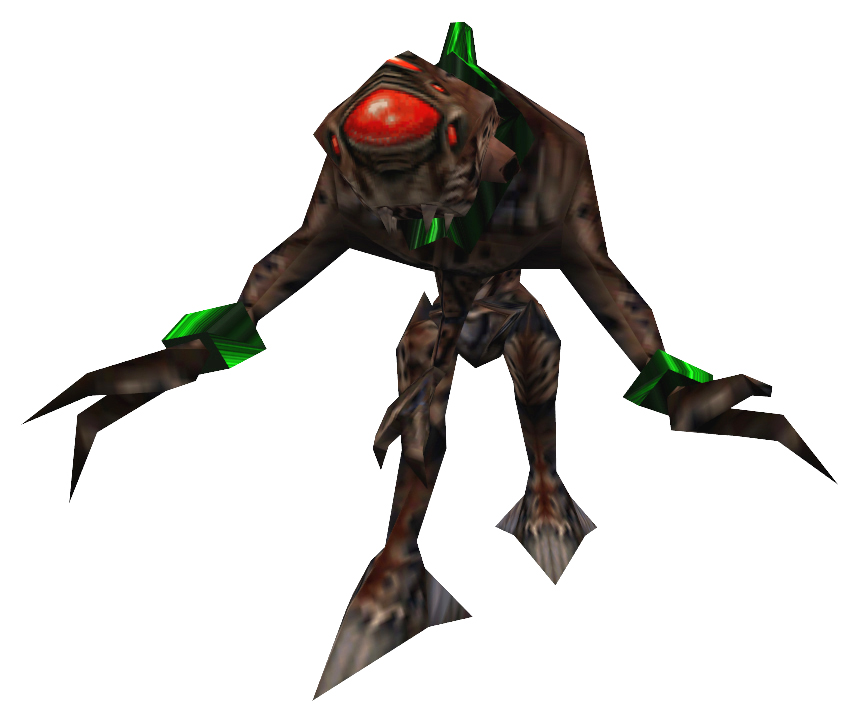
One way of teaching this is through things that are hinted at but never really said to the player. The Half Life series (if you'll pardon the favoritism) excels at this. The player may notice in the first game that some of the monsters are sentient and some aren't, that the sentient ones are wearing chains, that they don't seem native to the place they're teleporting in from, and that the sentients don't get along with the animals, but the larger truth- that they're escaped slaves running from something much bigger and more threatening- is only made clear in Half Life 2.
A "Vortigaunt" in its late-90s graphical beauty. The collar and shackles probably weren't the first thing you noticed, were they? |
Another way to bring metaphysics in is to state outright that there's something deeper, and to make it a part of the game. The game Fez is a 2D platformer set in a 3D world, where the players' perceptions change their environment. Portal, Braid, Quantum Conundrum, Antichamber, and plenty of other puzzle games have this as a matter of due course- the player must understand key (mechanics/facts about the world they find themselves in) to make it through to the end. To a limited degree, you could say that a game like Link to the Past also does this by having players move between a Light World and a Dark World.
This is mostly seen in fantasy, horror, and puzzle games, but there is a way to fit it into most games: establish a set of rules, ensure that the player understands them, and then include something which explicitly breaks them. This has to be introduced at the right time, because the player will just find it absurd and unfair if they're defeated by a new threat that doesn't follow the rules, but it can be a useful way of making players ask "What's really going on here?"
It would even be possible to make an entire game with actual rules which conflict with the rules given to the player, or just not giving the player the rules at all, but that way Mao and madness lies.
Sources:
Antichamber - Launch Trailer. GamersCentralDE. 3 Feb 2013. YouTube. 23 Sept 2014.
Banach, David. "Plato's Theory of Forms" 2006. St. Anselm's College. 23 Sept 2014.
Forrest, Barbara. "Methodological Naturalism and Philosophical Naturalism: Clarifying the Connection" Fall 2000. Philo, Vol. 3, No. 2, pp. 7-29, reprinted: Internet Infidels, The Secular Web. 23 Sept 2014.
Inwagen, Peter van. "Metaphysics" 10 Sept 2007. The Stanford Encyclopedia of Philosophy. 23 Sept 2014.
Plato. The Republic: Book VII. Project Gutenburg: 27 Aug 2008. 23 Sept 2014.
Ray, Gene. "TIME CUBE 4CE" 1997. 23 Sept 2014.
Sapp, Doug. "The Rules for Mao". 23 Sept 2014.
No comments:
Post a Comment