This is one field that game designers are already very fond of, so it's a perfect jumping-off point. Not to mention that most people have a common-sense grasp of it to begin with. People might not know the word "utilitarianism", for instance, but they could recognize the concept pretty easily. There are already games that exemplify personal conflict between moral systems- usually through moral dilemmas- and leave the player to decide for themselves what they can live with.
Games have been trying to give options towards moral and immoral ever since Gary Gygax invented D&D's alignment system, and they continue to exist today with the Paragon/Renegade paths in Mass Effect games, the choices shown in Infamous, and plenty of other basic decisions that can be added to games with little effort.
This lets designers include non-intrusive mechanics that make the player feel more individual, and more special, without putting much time or effort in- by all rights, a "morality bar" is a useless concept unless the player has an implicit goal to reach one end of it. Because of this, most games which feature them require that you be one extreme or the other, or as Zero Punctuation's Ben Croshaw put it, "Mother Teresa or baby-eating", before the very end.
If I decide to do something more fun to me, like avoiding killing anything for the added challenge of pacifism, but also stealing from lots of people to make up for the necessary resources I can't get from kills, I'm on neither end of the scale, and all of the best paths are closed to me. I'm not good or evil, I'm creative and pragmatic, and the game doesn't reflect that because there are only so many variables you can program into a graph before it becomes incomprehensible. This is not a good example of how ethics work, or how they should. What's worse, any scale like this is doomed to fail, and a lot of games that could benefit from a morality-mechanic just don't have the budget and time to build a complicated-enough substitute.
The answer to this problem lies in an arcade game (later adapted into an Atari 2600 cartridge) named Missile Command. Missile Command first arrived in 1980, and it had a very simple trackball-and-buttons control system. I was lucky enough to find one in an Indiana restaurant in 2013, and I know from experience that it is punishingly difficult.
The game is simple enough- there are 6 cities at the bottom of the display, and nuclear missiles fall at each of them. The player controls a targeting reticule and the missiles of the cities- when a button was pressed, the appropriate city would fire a missile which intercepts the reticule's current location. When a city's destroyed, it's destroyed permanently, and there are no extras to accumulate. The game is simply a battle against the odds.
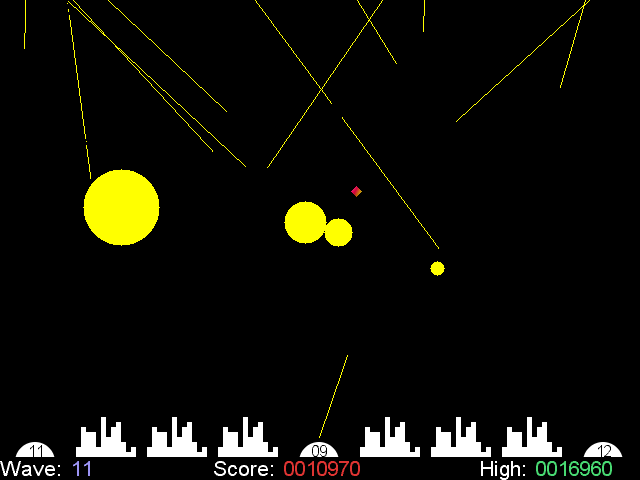
Missile Command, without words, asks a horribly difficult question: what are you willing to sacrifice? The game is manageable at first, but there is no win-condition, and you only lose only all 6 cities are destroyed. Do you let one be destroyed in a nuclear explosion to keep the other 5 better-protected, or do you risk having to stop two or three missiles at once and freezing up? Although it's made of the simplest polygons, this game was meant to convey dread, and that's a job it does well.
Dread, as it happens, is wonderful soil for tough moral decisions. For instance, Pathologic, a Russian game that has been described by its biggest fans as not remotely fun, is full of moral uncertainties. In it, the player is one of three healers in a town on the Russian steppe, which is hit by a mysterious and malevolent disease known as sand plague. Staying alive means allocating your resources well, ingratiating yourself with others in the town, learning to game the local economy as it falls apart, and fighting to keep yourself and others alive. These goals often come into conflict, and you must weigh the chances of your survival against the death of other people.

In Missile Command and Pathologic, there's no need for a morality bar. In Pathologic, there is the exception that people will dislike you if you do certain things, and you must be philanthropic to regain their trust, but this is just another way of setting a dilemma (being liked in the unstable town full of murderous people vs. keeping that life-saving medicine you might need in a day's time). The player must always be responsible for their own actions, and when the options aren't divided into a fixed dichotomy and given point-values, it suddenly becomes a lot more troubling.
This is a simple method for turning a philosophical quandary into something playable- to be more specific, the Trolley Problem. The Trolley Problem, which was first written in 1967 by Phillipa Foot, is set up like so: a runaway trolley is coming down the railroad tracks, heading straight for five people who are tied to them, and you're at the lever which switches tracks and can prevent this, but the side track has one person tied to it. Your only options are to do nothing or to pull the lever- answers like pulling it halfway and derailing the trolley are clever, but they're not the point of the exercise. Which is the correct answer to this problem?

It's a question of resources, not conceptually any different from having only so many bullets or heals for a certain target. You have the ability to perform one of two actions, and each one will lose you something the other would've given you. That's the simplest way to make someone agonize over a decision, whether it's deciding whether to pull the lever or working out which Perks you really want in a Fallout game. It forces whoever participates in it to figure out which things they value most, and to do so under time-pressure.
Of course, as previously stated, sometimes budgets of one kind or another are just too small, and a bar's all a studio can fit into their game. For that, the best way to make things more interesting, as the Extra Credits team has pointed out (see below), is to add another two categories, rename all of them, and make it a line graph instead.
For instance, in a Tolkienesque fantasy game, the four qualities could read something like "lawful" and "anarchic" or "Dwarven" and "Elven". For the sake of the example, let's say that lawful-anarchic and Dwarven-Elven are our dichotomies. Instead of netting you a simple plus or minus, every decision is now multifaceted- yes, that decision will open up more anarchic opportunities, and I don't want to be a self-righteous bureaucrat or anything, but is that really worth losing my rapport with the elves? For a different challenge in the same theme, you could judge the player for their decisions based on oddball or alien standards.
Morality is often seen as something we achieve rather than do, but in a game-environment "achieve" can be a loaded word. Trying to maximize your score in the direction that happens to be named "good" is very different from making the toughest decisions and learning what you really are and aren't willing to do, and while the former is surely more fun for some, the latter is more rewarding in the long-term. Games are a sandbox, and deciding that some action is wrong is much better in a simulation than making that mistake out in monkeyspace.
Sources:
Aristotle. Ethics: The Nichomachean Ethics. Baltimore: Penguin, 1966. Print. 7 September 2014.
BIOSHOCK (Zero Punctuation). Ben "Yahtzee" Croshaw. 21 July 2011. The Escapist/YouTube. 10 September 2014.
Clark, Josh. "How the Trolley Problem Works" 03 December 2007. HowStuffWorks.com. 10 September 2014.
Rubens, Alex. "The Creation of Missile Command and the Haunting of Its Creator, Dave Theurer" 15 August 2013. Polygon.com. 10 September 2014.
Smith, Quintin. "Butchering Pathologic" 10 April 2008. Rock Paper Shotgun. 9 September 2014.
Video Games and Moral Choices. James Portnow, Daniel Floyd, & Allison Theus. 16 April 2010. The Escapist/YouTube. 10 September 2014.
I am totally loving your blog. The tone is right, the content thought-provoking, and the background research is solid. More more more!
ReplyDelete